

An earlier report by Energy Ventures Analysis (EVA) (Part 1) showed the performance of coal, gas, oil, nuclear, hydro, wind, and solar power in meeting the higher electricity demand during Winter Storm Fern. The report found that the coal fleet performed well during Fern, natural gas also made an important contribution, wind underperformed compared to previous winter storms, and solar also underperformed because of cloud cover and ice-covered panels. Part 2 of the report (which accompanies Part 1) shows how the coal fleet helped to hold down electricity prices during Fern.
Besides their many reliability attributes, coal plants also limit increases in electricity prices when other fuels are too expensive or in short supply. This way, the coal fleet acts as an insurance policy to protect against large upward swings in electricity prices. In particular, natural gas prices typically spike during extreme winter weather. For example, the price of natural gas delivered to power plants in PJM rose from almost $3.00/MMBtu before Fern to more than $87/MMBtu during Fern. Increases in natural gas prices in turn drive up electricity prices.
To illustrate the effect of the coal fleet on power prices, EVA assumed that the coal fleet was removed from the grid in four regions of the country – PJM, MISO, ERCOT, and SPP − when Fern peaked. Removing coal means these regions, which collectively have 110,000 megawatts of coal, would have been forced to rely more on natural gas power plants at a time when gas prices are high.
The cost savings due to the coal fleet were calculated as the difference on the peak electricity demand day between (1) power prices with each region’s coal plants operating (“with coal”) and (2) power prices in each region without any coal plants (“without coal”). The chart below shows power prices ($/MWh) on the peak demand day in each region without (red) and with (black) its coal fleet. Without coal, power price increases ranged from roughly 50% to almost double.
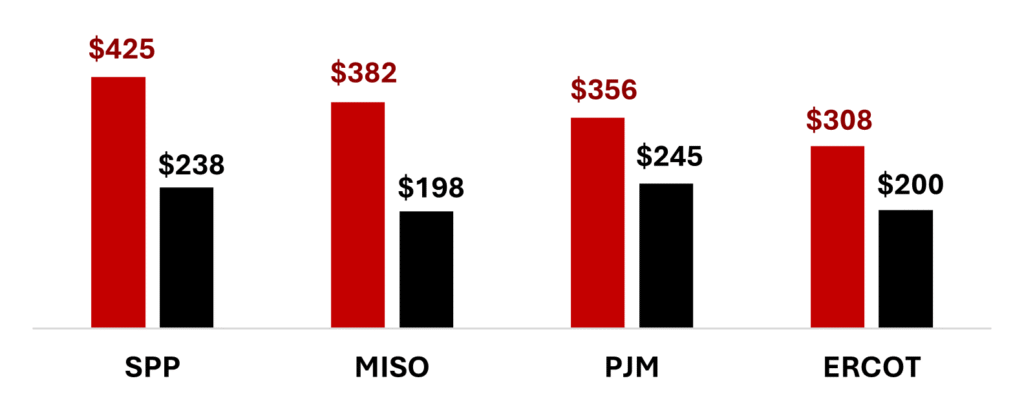
The increase in power prices without coal totaled almost $1.15 billion for all four regions on the day Fern peaked. Put another way, the savings from having coal as part of the generation mix totaled almost $1.15 billion on the day the storm peaked. Note that these savings are for a single day, not the entire duration of Fern which lasted several days. For that and other reasons, these estimated savings are conservative. (The EVA report explains these reasons.) The table below shows the savings for each region.
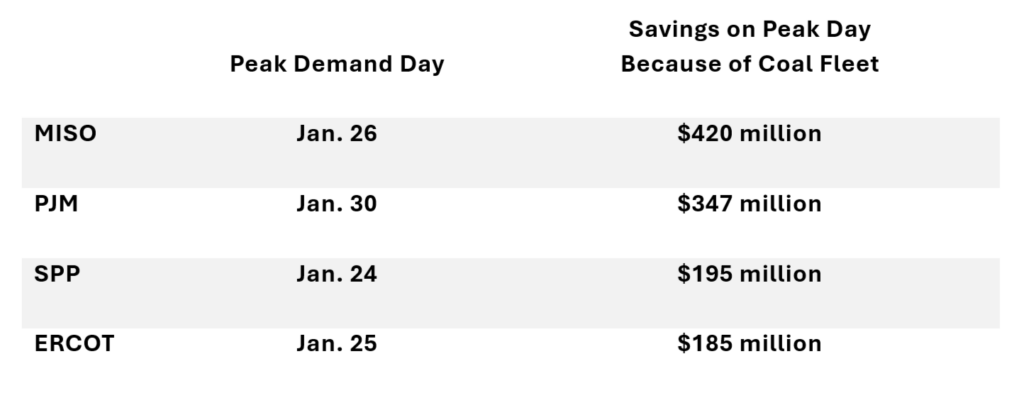
These savings illustrate the value of the coal fleet as an insurance policy for ratepayers that, in this case, was worth more than $1 billion on a single day. Despite the value of coal, utilities have announced plans to retire one-third of the coal fleet over the next five years. The EVA analysis provides another compelling reason to reverse these retirement plans.