

“The overall resource adequacy outlook for the North American BPS is worsening …” NERC December 2025
The North American Electric Reliability Corporation (NERC), which is responsible for monitoring the reliability of the electric grid, issued its annual “Long-Term Reliability Assessment” (LTRA) last week. The 2025 LTRA assesses grid reliability across the United States and parts of Canada and Mexico over a ten-year period, with an emphasis on reliability risks over the five-year period 2026-2030.
The new assessment is another warning about the increasing risk of electricity shortages. NERC’s 2022 LTRA projected that one-fourth of the U.S. − mostly several states in the middle of the country − was at “high risk” of electricity shortages. However, the new LTRA shows the “high risk” of shortages has spread to more than half the U.S., spanning from the Mid-Atlantic to the Pacific Northwest (NERC map below).
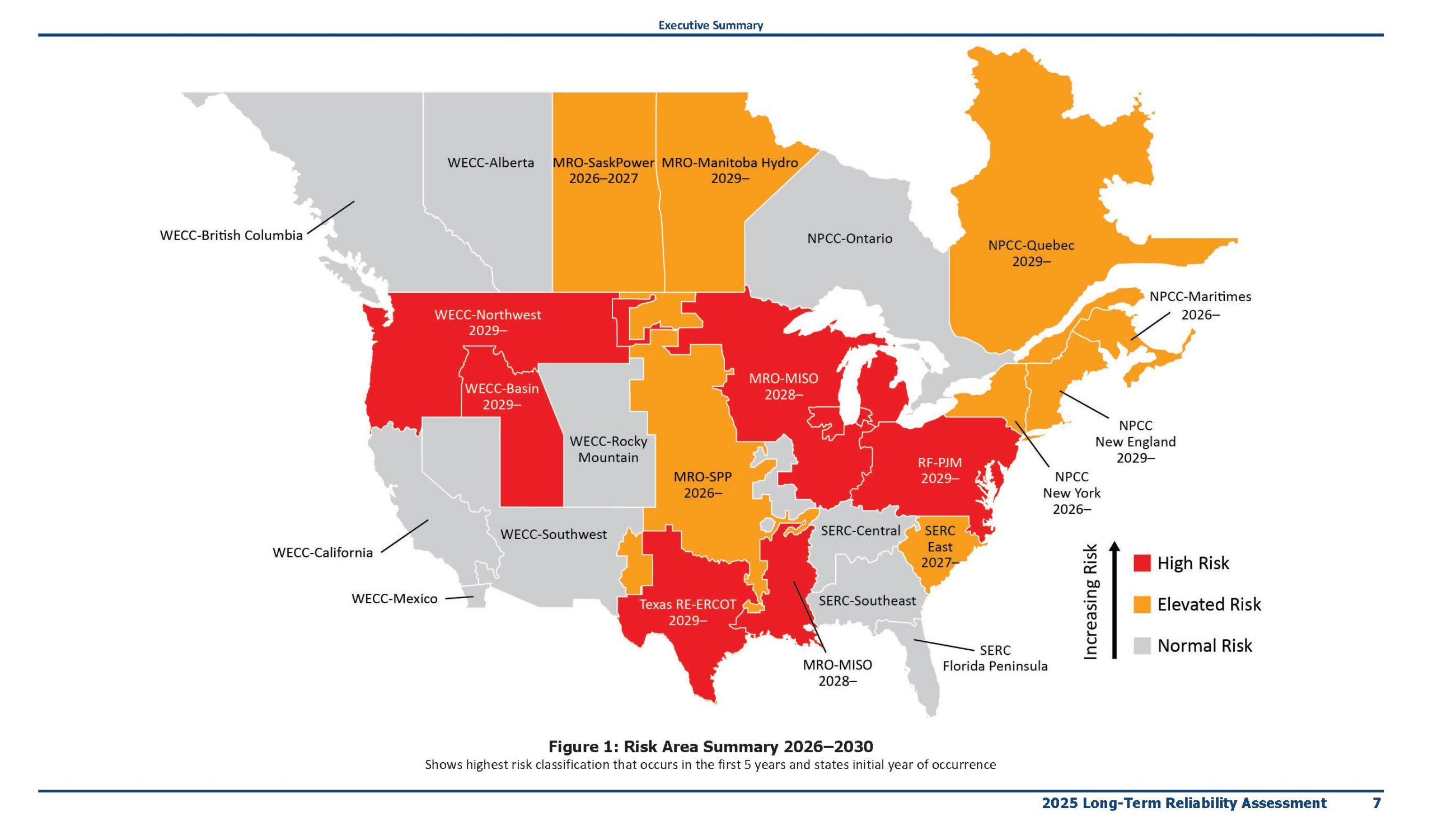
There are several reasons for NERC’s worrying projection. One is the increasing demand for electricity caused by new data centers and the digital economy. NERC estimates that an additional 245,000 megawatts (MW) of power will be needed by 2035. For perspective, this enormous increase is more power than either the entire PJM or MISO grids can currently provide.
Another reason is the premature retirement of coal power plants. Utilities have announced plans to retire more than 55,000 MW of coal-fired generating capacity over the same five-year period that NERC is projecting risks of electricity shortages. Most of this retiring coal capacity is located in NERC’s “high risk” regions. Reversing these retirements would reduce the need for new power by one-fourth and also save money.
Analysis suggests that reversing coal plant retirements could save ratepayers $3 billion or more per year compared to replacing coal plants with weather-dependent sources of electricity. Besides costing more to replace, the nation’s electric grid will lose an energy-secure and reliable source of baseload power. For example, coal power plants have been critical to keeping the lights on during Winter Storm Fern, just as they have during past winter storms. According to U.S. Energy Information Administration analysis, coal power plants increased their electricity production during Fern more than any other source of electricity.