

National Coal Council
- Home
- National Coal Council
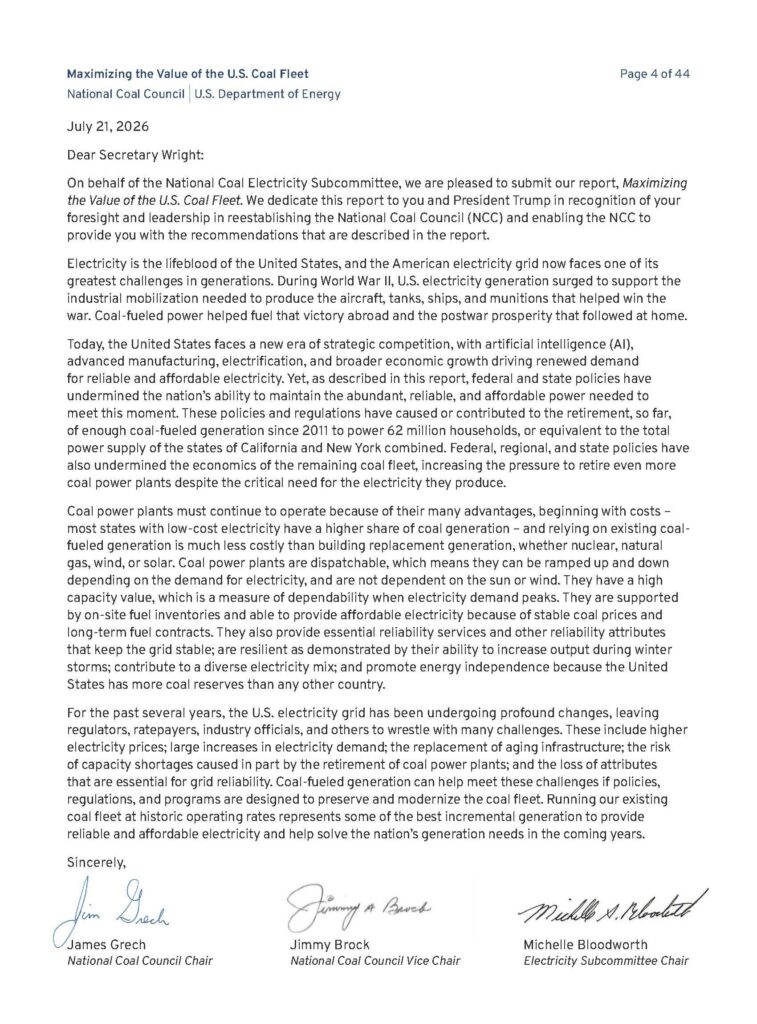
Report: Maximizing the Value of the Coal Fleet
What is the National Coal Council?
The National Coal Council (NCC) advises the Secretary of Energy on coal
and related issues. It was reestablished in June 2025. The NCC includes
more than 60 members representing various parts of the coal value chain.
Jim Grech, President and CEO of Peabody Energy, is Chair, and Jimmy
Brock, Chairman and CEO of Core Natural Resources, is Vice Chair.
Learn more abut the NCC and this Report
What is the National Coal Council?
- The National Coal Council (NCC) advises the Secretary of Energy on coal and related issues. It was reestablished in June 2025.
- The NCC includes more than 60 members representing various parts of the coal value chain. Jim Grech, President and CEO of Peabody Energy, is Chair, and Jimmy Brock, Chairman and CEO of Core Natural Resources, is Vice Chair.
What is the purpose of the report?
- The report provides recommendations to enable the existing coal fleet to help meet rapidly rising electricity demand while promoting grid reliability, affordable electricity, economic growth, and national security.
- Electricity demand is growing after roughly 15 years of little change, driven by artificial intelligence, data centers, advanced manufacturing, electrification, and broader economic growth. At the same time, 60 GW of coal-fueled generation have announced plans to retire by 2035. The report’s recommendations are intended to reverse these retirements.
Who developed the report?
- The NCC Electricity Subcommittee prepared the report with input from the entire NCC. Michelle Bloodworth, President and CEO of America’s Power, chaired the subcommittee.
- The report was submitted to DOE at the NCC’s July 21, 2026 meeting.
What are the report's main findings?
- The existing fleet comprises 168 GW of coal generation across 37 states. These plants are dispatchable, reliable, resilient, and fuel secure.
- Running the fleet at historic operating levels could help meet projected electricity demand growth.
- Preserving and modernizing existing coal power plants is generally less expensive than replacing them with new generation and infrastructure which can take years to build.
- The report concludes that the fleet’s decline has not been caused by market forces alone. Regulations, state mandates, subsidies for competing resources, retirement agreements, and electricity market rules have contributed to premature closures and discouraged investment.
How are the recommendations organized?
- The report provides 19 recommendations: six regulatory reforms, seven electricity market reforms, four recommendations for financial support, and two recommendations concerning new coal power plants.
- Together, the recommendations form a strategy to preserve and modernize the existing fleet, strengthen its supply chain, and restore the option to develop new coal generation.
What regulatory reforms does the report recommend?
- Revise or repeal EPA rules that threaten coal power plants, including rules covering carbon emissions, wastewater, coal ash, plant modifications, air toxics, ozone transport, and regional haze.
- Require DOE, EPA, federal electricity regulators, and grid operators to examine the reliability consequences of proposed regulations. The federal government should also work with states and plant owners to modify retirement agreements when needed to protect reliability.
- Continue streamlining federal coal leasing, mine approvals, and permitting, and have Congress provide durable policy certainty so plant owners can make long-term investment decisions.
What electricity-market reforms does the report recommend?
- Correct market rules that allow subsidized resources to bid at zero or negative prices and improve how grid operators measure the dependable capacity provided by different electricity sources.
- Explicitly recognize and compensate services such as on-site fuel, the ability to operate when called upon, generator upgrades, and performance during extended periods of system stress.
- Extend longer-term reliability agreements for plants needed to keep the grid dependable, rather than relying only on temporary emergency orders.
- Encourage direct contracts and co-location between existing coal power plants and large electricity users, including data centers, through faster interconnection and permitting.
What financial support does the report recommend?
- Expand and streamline DOE grants and loan guarantees for projects that preserve and modernize existing coal power plants.
- Use long-term federal power purchases and the Defense Production Act to support the coal fleet, domestic equipment manufacturers, replacement-parts suppliers, and other critical infrastructure.
- Ensure that coal power plants dependent on particular coal sources retain access to the necessary leases, permits, transportation, and other supply-chain resources.
What does the report say about new coal power plants?
- Preserving the existing fleet is the immediate priority, but the report also calls for building new coal generation.
- DOE should provide grants and loan guarantees to new coal projects and identify regulatory, financial, and other barriers that prevent projects from moving forward.
- The sites of retired coal power plants may be strong candidates for new plants because many already have transmission access, water, transportation infrastructure, experienced workers, and community support.
Who would be responsible for implementing the recommendations?
- The recommendations call for actions by DOE, EPA, the Department of the Interior, the Federal Energy Regulatory Commission, grid operators, Congress, states, and plant owners.
- The report recommends that DOE establish a system to track implementation.
Secretary Chris Wright
Department of EnergyMichelle Bloodworth
President and CEO of America’s PowerJimmy Brock
President and CEO of CONSOL EnergySecretary Doug Burgum
Department of InteriorSecretary Doug Burgum
Department of InteriorAdministrator Lee Zeldin
Environmental Protection AgencyJim Grech
President and CEO of Peabody Energy.@Sonderling47: “Today’s agreement ensures that @USDOL and @ENERGY will work side by side to prepare the mining workforce, advance mining technology, and support the safe production of the coal that powers America’s future.”
— U.S. Department of Labor (@USDOL) July 21, 2026
READ BELOW ⬇️ https://t.co/Cd4MWFx9Tp
The Trump EPA will continue to unleash reliable, durable, and affordable American made energy, reversing the damage caused by the war on coal waged by the Obama and Biden Admins. Just joined this morning’s National Coal Council meeting alongside NEDC leaders @SecretaryBurgum and… pic.twitter.com/KMbTiyY4U2
— Lee Zeldin (@epaleezeldin) July 21, 2026
On day one, @POTUS ended the war on beautiful, clean coal.
— Secretary Chris Wright (@SecretaryWright) July 21, 2026
Today, @ENERGY convened the National Coal Council and signed a Memorandum of Understanding with @USDOL to strengthen opportunities for the next generation of American miners. pic.twitter.com/TmGUUo9Q6W