

The conflict in Iran vividly reinforces the fact that America’s domestic coal fleet remains an essential pillar of our national security and ability to weather acute geopolitical tensions. As global fuel markets tighten and natural gas supply chains are disrupted, many more vulnerable countries in Asia and Europe are turning back to coal to maintain grid reliability and protect their economies.
Recent coverage from the New York Times, Bloomberg, Semafor, and a number of other leading publications shows how the conflict in Iran has constrained natural gas supply and increased volatility across global markets, prompting major economies to increase coal use in response.
The New York Times reports, “Already, officials in Japan, Bangladesh and Thailand, which typically buy gas from Qatar, have taken steps to burn more coal to produce electricity. South Korea, meantime, is urging residents to conserve energy, including by taking shorter showers.”
These countries, which lack sufficient domestic coal capacity, are now being forced back into global markets to secure supply, often at higher cost and with greater urgency, underscoring the risks of overreliance on fuels like liquefied natural gas that depend on fragile international supply chains.
Thanks largely to our ample supply of coal, the United States is in a significantly better position to weather these market disruptions. The U.S. has the largest coal reserves in the world with 249 billion tons of recoverable coal reserves. At current production levels, that is enough supply to last 440 years.
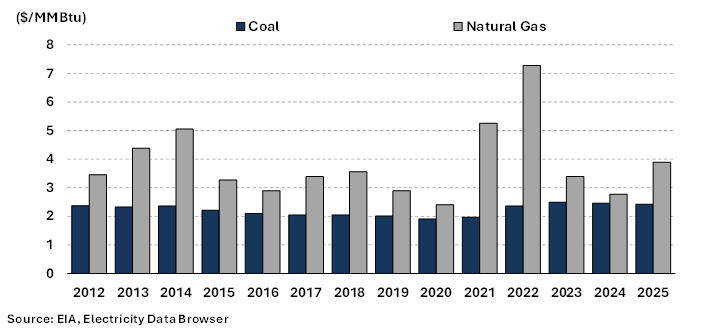
Coal also provides stability to domestic energy markets. Fuels like natural gas, which are directly influenced by spot market prices, are prone to greater volatility during global conflicts like the one in Iran. By comparison, the cost of coal to generate electricity remains remarkably consistent, providing greater certainty for consumers and the economy as a whole.
Beyond its ability to withstand global market disruptions, coal’s price stability also helps the United States respond better to extreme weather events (see chart on page 2). Earlier this year, during Winter Storm Fern, electricity demand surged across large parts of the country and strained the grid. Coal generation increased significantly during peak periods and played a central role in maintaining reliability and limiting price spikes. Analysis from Energy Ventures Analysis showed that coal capacity factors rose sharply across multiple regions. Without coal, peak-day prices in major markets would have been substantially higher.
Average Cost of Coal and Natural Gas for Electricity Generation[i]
The Iran conflict is demonstrating on a global scale that electricity grids worldwide depend on resources that are available on demand and capable of operating despite external disruptions. Coal uniquely provides these attributes. It delivers on-site fuel security and dependable output without reliance on continuous imports or vulnerable transportation infrastructure.
Countries that prematurely shut down coal plants are now facing the consequences of their decisions, but the United States does not need to suffer that same fate. We have the coal resources necessary to maintain a balanced and resilient energy system. Recent events serve as additional proof that keeping U.S. coal plants open is essential to maintaining reliability, strengthening energy security, and sustaining American economic and national security interests.
[i] EIA, “Electricity Data Browser,” accessed March 12, 2026.